
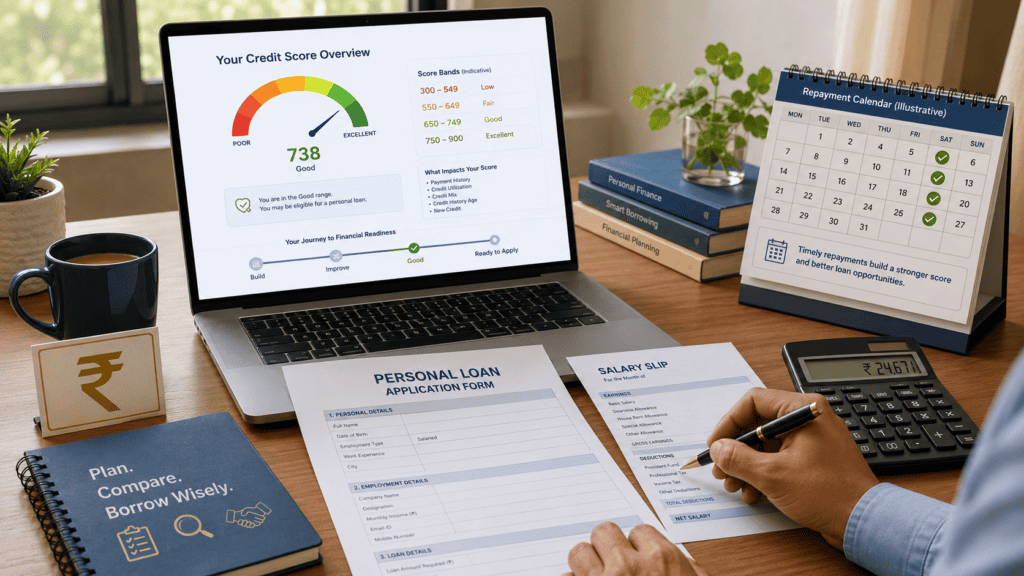
You want a personal loan. You have checked your CIBIL score and are not sure whether it is strong enough to apply. Worse, you have heard that applying to multiple banks and getting rejected can actually damage your score further — and you do not know if that is true. This is exactly the kind of moment where bad information costs money. Personal loans are unsecured — there is no home or car as collateral — so lenders depend heavily on your credit history to decide whether to approve you, how much to lend, and at what interest rate. There is no single universal minimum CIBIL score that every lender in India uses as a cutoff. Different banks, NBFCs (Non-Banking Financial Companies), and digital lenders have different norms, and your income, FOIR (Fixed Obligation to Income Ratio), employer profile, and existing EMI burden all shape the final decision alongside your score. This article explains what score ranges typically mean for personal loan approval, what else lenders actually check, and what you should do before sending a single application.
Quick Answer: Minimum CIBIL Score for Personal Loan
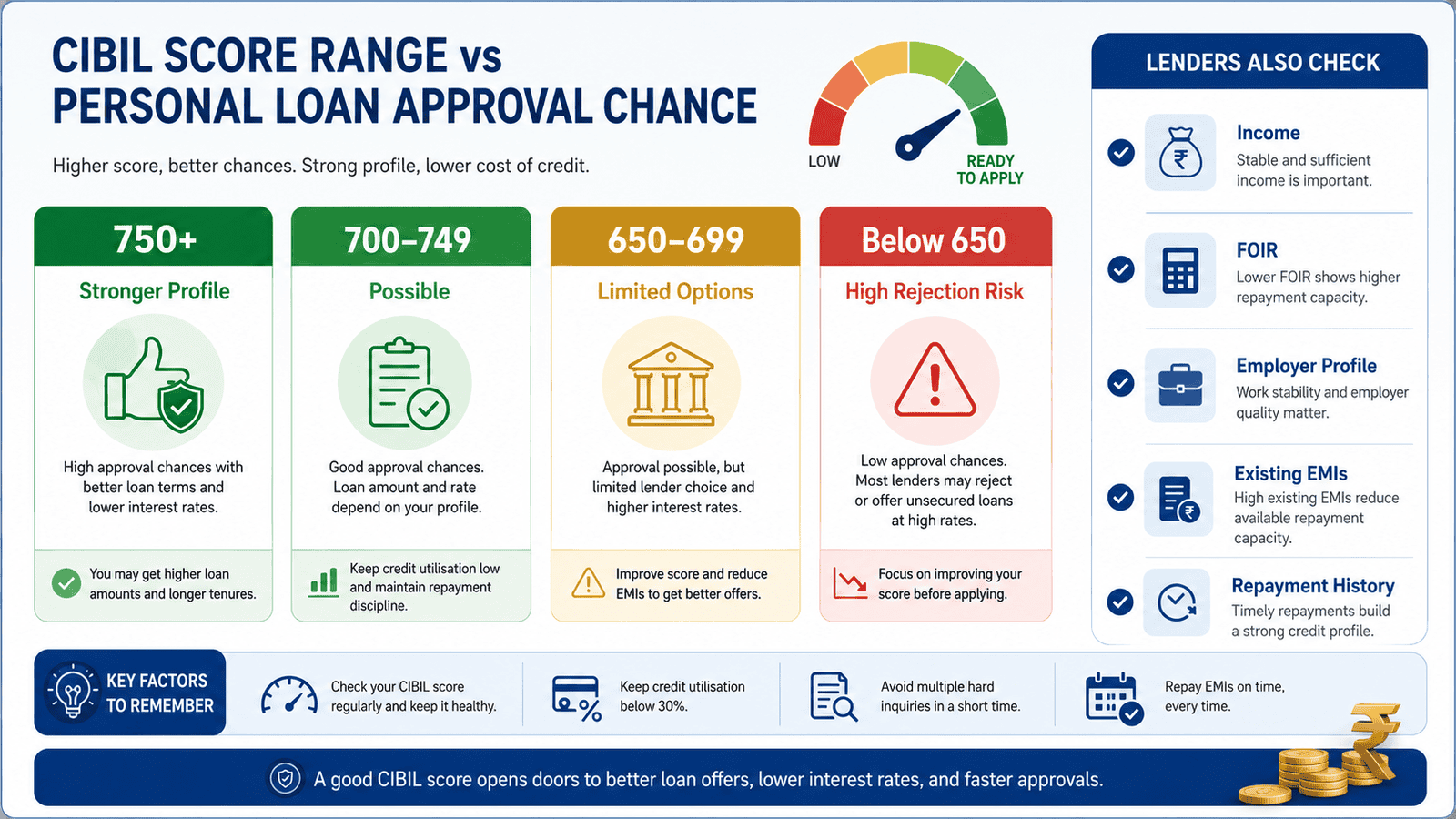
The minimum CIBIL score for personal loan approval is usually around 750 for stronger chances, but lenders may consider 700–749 depending on income, FOIR, employer profile, and repayment history. A lower score does not guarantee rejection, but may mean stricter terms. Score thresholds vary by lender — verify directly with the lender before applying.
Key Takeaways
- A CIBIL score around 750 is generally treated as a stronger profile for personal loan approval, but a higher score alone does not guarantee the loan — lenders also check your monthly income, FOIR, employer category, and repayment history before making a final decision.
- If your score falls in the 700–749 range, some lenders may still consider you, but approval typically depends on how strong your income, bank statement, and existing EMI burden look — expect more scrutiny on documentation.
- A lower score at 650–699 significantly narrows your lender options and may result in a reduced loan amount, shorter tenure, or a higher interest rate — which means higher total repayment even if you are approved.
- On a ₹3 lakh personal loan, the difference between a 12% and an 18% interest rate (illustrative) over 3 years can mean paying ₹29,441 versus ₹46,092 in total interest — a difference of over ₹16,000 that borrowers with lower credit profiles often absorb without realising it.
- Checking your own CIBIL score is normally a soft inquiry and does not affect your score — but every time you formally apply for a loan, the lender performs a hard inquiry, which can reduce your score slightly and leave a record on your credit report.
- Multiple loan applications within a short period — even with the same intent — appear as multiple hard inquiries and can signal credit distress to future lenders, making it harder to get approved even if your score was borderline acceptable before.
- Before applying, check your full credit report for errors, calculate your FOIR, and compare the total repayment cost — not just the EMI — across shortlisted lenders to make a decision that protects your credit and your wallet.
CIBIL Score Ranges and Personal Loan Approval: What to Expect
| CIBIL Score Range | Likely Approval Profile | Typical Borrower Action |
|---|---|---|
| 750 and above | Stronger profile — more lenders likely to consider; better terms possible | Shortlist 2–3 suitable lenders and compare total cost before applying |
| 700–749 | Possible approval — lender-dependent; income, FOIR, and employer stability matter more | Reduce existing EMI burden if possible; apply to one well-matched lender first |
| 650–699 | Limited lender options; higher interest or stricter terms likely if approved | Check credit report for errors; resolve overdue dues before applying |
| Below 650 | Higher rejection risk at mainstream banks; alternatives may carry significantly higher costs | Pause applications; focus on credit repair before reapplying |
| No credit history | Thin file — some lenders may consider with strong income proof; terms may be less favourable | Build credit via secured card or small credit product before taking a large unsecured loan |
All score bands above are indicative. Actual lender cutoffs vary and may change. Verify directly with your lender before applying.
Why CIBIL Score Matters More for Personal Loans
A CIBIL score — calculated by TransUnion CIBIL (transunioncibil.com) based on your credit history reported by lenders — is a three-digit number between 300 and 900. A score closer to 900 signals a strong repayment track record. A score below 650 suggests a history of delays, defaults, or high credit utilisation (the share of your total credit limit that you are using at any given time).
Personal loans are unsecured. There is no property, vehicle, or fixed deposit pledged as security. If you stop paying, the lender cannot simply seize a collateral asset to recover the money. That makes the lender’s risk much higher compared to a home loan or car loan. To compensate for that risk, lenders use your CIBIL score — along with several other signals — to decide whether to approve you, how much to lend, and what interest rate to charge.
According to TransUnion CIBIL, credit scores in India are calculated using repayment history, credit utilisation, length of credit history, credit mix, and new credit inquiries. DPD — Days Past Due — is a key signal inside your credit report. If your credit report shows DPD entries (meaning you paid an EMI or credit card bill more than 30 days late), lenders may flag this even if your overall score is reasonable.
The key point is this: your CIBIL score affects not just whether you are approved, but also the terms of the loan. A lower score may mean a higher interest rate, a lower approved loan amount than you asked for, a shorter tenure, or more documentation requirements. Understanding this early helps you apply strategically rather than reactively. To understand how personal loan score expectations fit into broader good score for loans benchmarks used across all loan types, it helps to review what each score band means in practice.
What Else Lenders Check Beyond Your CIBIL Score
Your CIBIL score opens or closes doors, but it does not operate alone. Every personal loan lender in India runs a multi-factor eligibility check. Here are the major signals they look at:
| Factor | What the Lender Checks | Why It Matters |
|---|---|---|
| Monthly income | Salary slip, Form 16, bank statement credits | Determines whether you can comfortably afford the EMI |
| FOIR (Fixed Obligation to Income Ratio) | Total existing EMIs ÷ gross monthly income | Most lenders prefer FOIR below 50% before adding a new loan EMI |
| Employer category | Whether employer is a listed company, PSU, MNC, or smaller private firm | Salaried applicants at top-tier companies are seen as lower income-risk |
| Repayment history | DPD entries, loan closures, credit card payment pattern | Even one DPD-90 entry can trigger rejection or higher rate |
| Credit utilisation ratio | Total credit card balance ÷ total credit limit | Utilisation above 30–40% can signal credit dependency to lenders |
| Existing loan count | Number and type of open loans and credit cards | Too many open credit lines increase perceived repayment risk |
| Bank statement behaviour | Income consistency, average balance, EMI bounce history | Lenders look for salary regularity and no bounced payments |
FOIR (Fixed Obligation to Income Ratio) deserves special attention. It is calculated as:
FOIR = (Total existing EMIs per month ÷ Gross monthly income) × 100
Where: Total existing EMIs = all current loan and credit card minimum due payments | Gross monthly income = pre-tax salary or business income
If your FOIR is already at 45% before a new personal loan EMI is added, many lenders will either reduce the approved loan amount or decline the application entirely — regardless of your CIBIL score.
Real Example: Rohit’s Loan Application in Pune
Rohit is 31 years old, works as a software executive in Pune, and earns ₹55,000 per month (illustrative). He wants a ₹3 lakh personal loan for a family medical emergency. His CIBIL score is 682 (illustrative — used as a 650–699 band example). He already pays ₹12,000 per month as EMI on an existing two-wheeler loan.
Before Rohit’s score becomes the issue, his FOIR is already at 21.8% (₹12,000 ÷ ₹55,000). If a ₹3 lakh personal loan at 18% (illustrative) over 3 years adds an EMI of approximately ₹10,849, his FOIR would rise to 41.5%. That may still be within acceptable range for some lenders. But with a CIBIL score of 682, many private banks may not approve him at standard rates. Some NBFCs may offer approval, but at a higher interest rate — which pushes total repayment significantly higher.
If Rohit were to close his two-wheeler loan first and spend three to four months clearing his credit card outstanding before applying, his score might improve and his FOIR would drop — potentially making him eligible at a lower rate. The lesson: the same salary and loan amount can lead to very different outcomes depending on the credit and repayment profile at the time of application. All numbers above are illustrative; actual outcomes depend on lender policy at the time of application.
Application Readiness Checklist: Are You Actually Ready to Apply?
Before you apply anywhere, run through this checklist. It takes less than a day and can save you from rejection and unnecessary hard inquiries on your credit report.
| Action | Why It Helps | Risk If Ignored |
|---|---|---|
| Check your full credit report (not just the score) | Identifies wrong entries, DPD marks, and unrecognised accounts | You may apply with an avoidable negative entry on your report |
| Calculate your FOIR before applying | Shows whether a new EMI is actually affordable within lender limits | Application may be rejected or approved at a lower amount than needed |
| Clear overdue credit card dues and EMIs | Removes active negative signals from your profile | Even one overdue account can trigger automatic rejection |
| Check your salary slip and bank statement consistency | Income credits must match the salary shown in documents | Inconsistent bank statements are a red flag for lenders |
| Review employer category if applying at a bank | Banks sometimes list approved employer categories for personal loans | Non-listed employer may need extra documentation or face a lower eligible amount |
| Dispute wrong entries before applying | Errors on credit reports can reduce your score unfairly | A correctable entry may cost you approval or a better rate |
You can check your CIBIL score free from TransUnion CIBIL’s official website and access one free credit report per year. Separately, reviewing your personal loan eligibility factors across income, age, documents, and employment helps you go beyond the score and understand your full application picture before submitting anything.
How a Lower Score Increases Your Total Loan Cost
Many borrowers focus on whether they will be approved. The more important question is: what will the loan actually cost? A lower CIBIL score often leads to a higher interest rate — even on the same loan amount from the same lender. Over a multi-year tenure, that difference compounds.
Consider this illustrative example using a ₹3 lakh personal loan:
EMI = [P × r × (1+r)^n] ÷ [(1+r)^n − 1]
Where: P = Principal loan amount | r = Monthly interest rate (annual rate ÷ 12) | n = Number of monthly instalments
| Scenario | Loan Amount | Interest Rate (Illustrative) | Tenure | Monthly EMI | Total Repayment | Total Interest Paid |
|---|---|---|---|---|---|---|
| Strong credit profile | ₹3,00,000 | 12% per annum | 3 years | ₹9,957 | ₹3,58,452 | ₹58,452 |
| Borderline credit profile | ₹3,00,000 | 18% per annum | 3 years | ₹10,849 | ₹3,90,564 | ₹90,564 |
| Borderline credit profile — longer tenure | ₹3,00,000 | 18% per annum | 5 years | ₹7,615 | ₹4,56,900 | ₹1,56,900 |
All figures are illustrative. Interest rates used are not current market rates. Actual EMI and total repayment depend on the lender’s rate, processing fee, and other applicable charges at the time of application. Verify current rates with the lender before deciding.
The table shows two important things. First, a 6 percentage point difference in interest rate adds over ₹32,000 in total repayment over 3 years on a ₹3 lakh loan. Second, extending tenure to reduce EMI comfort is not free — on an 18% loan stretched to 5 years, you end up paying ₹1,56,900 in interest alone, which is more than half the principal you borrowed. Always compare total repayment, not just monthly EMI.
Bank vs NBFC vs Digital Lender: Which Suits Your Score?
| Lender Type | Typical CIBIL Approach | Approval Flexibility | Likely Cost and Risk |
|---|---|---|---|
| Public sector banks (PSBs) | Generally stricter on score and income documentation; employer category matters | Lower for borderline profiles; salary account relationship can help | Usually lower rates if approved; slower processing |
| Private banks | Score thresholds typically in the 720–750+ range (indicative — verify with each bank); income and employer stability are key | May reject at lower scores; pre-approved offers available for existing customers | Competitive rates for strong profiles; rates rise sharply for borderline approvals |
| NBFCs (regulated) | May consider borderline profiles at 650–700; more flexible on employer category | Higher approval flexibility — but not universal and not guaranteed at low scores | Processing fees may be higher; interest rates typically higher than banks; verify total cost |
| Digital lending apps (RBI-registered) | Some use alternative data alongside CIBIL; thin-file borrowers may qualify | Faster processing; higher approval rates for smaller ticket loans | APR (Annual Percentage Rate) can be significantly higher; always verify KFS (Key Facts Statement) before accepting |
Important note on digital lenders: RBI’s Digital Lending Guidelines require all regulated lenders to provide a Key Facts Statement (KFS) before loan acceptance. This document shows the all-in cost including processing fee, APR, and repayment schedule. Read it carefully before accepting any digital loan offer. If a lender or app claims guaranteed approval without checking your CIBIL or income, that is a warning sign — not a benefit. Verify the lender’s registration with RBI (rbi.org.in) before proceeding.
Borrower Safety Checklist Before Applying
- Do not apply to more than one or two lenders at the same time. Each formal application triggers a hard inquiry on your credit report. Multiple hard inquiries within a short period are visible to other lenders and can signal credit distress, making future approvals harder.
- Avoid any lender or app that promises “guaranteed approval” or “no CIBIL loan.” Regulated lenders assess repayment capacity. Unregulated apps that skip this step may trap you in high-cost debt with aggressive recovery practices.
- Always read the KFS (Key Facts Statement) before accepting. Under RBI’s Digital Lending Guidelines, regulated lenders must provide a KFS showing the APR, processing fee, and total repayment. If a lender cannot provide this document, do not proceed.
- Compare APR, not just EMI. A lower EMI with a longer tenure often means paying more in total interest. Calculate total repayment before deciding.
- Do not borrow just because approval is available. If your existing EMI burden is already high or your income is unstable, an approved loan can push you into a debt spiral. Approval does not mean affordability.
How to Decide What’s Right for You
your CIBIL score is 750 or above, your FOIR is below 50% after adding the new EMI, and your repayment history shows no DPD entries in the past 12 months — you are in a reasonably strong position to apply. Shortlist two to three lenders, compare total repayment cost, and apply to the best-matched one.
your score is between 700 and 749 — do not apply everywhere. Calculate your FOIR first. If it stays comfortably below 45% after adding the new loan EMI, apply to one lender that fits your profile rather than multiple banks simultaneously. A targeted application carries less risk than a scatter-shot approach.
your score is in the 650–699 range — check your credit report for errors before doing anything else. A wrong entry or unresolved overdue may be pulling your score down unfairly. Fix what can be fixed, then reassess. Consider whether the emergency can be addressed with a smaller loan amount that is easier to qualify for.
you are considering a secured option such as a loan against fixed deposit or gold loan — compare the total cost and the asset risk carefully. These options may carry lower interest rates, but you are pledging an asset, which carries its own risk if repayment becomes difficult.
your FOIR is comfortable, your repayment history is clean, and your score is in an acceptable range — do not apply yet. Spend one to three months paying down credit card dues, clearing overdue EMIs, and reducing utilisation. A score improvement of even 20–30 points can move you from a limited-lender situation to a wider range of options at lower rates.
Common Mistakes to Avoid
Applying to Multiple Lenders Without Checking Eligibility
Many borrowers apply to five or six lenders simultaneously hoping that one will approve. Every formal application triggers a hard inquiry — a lender-initiated check on your credit report. Each hard inquiry is recorded and slightly reduces your score. Multiple hard inquiries within weeks can signal financial distress to future lenders and reduce your chances of approval even if your score was borderline acceptable before.
Instead, use eligibility calculators or check lender pre-qualification tools (which usually run soft inquiries) before formally applying. Then apply to one well-matched lender. Read more about how multiple loan applications affect your CIBIL score before submitting applications.
Ignoring Credit Card Dues and High Credit Utilisation
A credit card balance of ₹45,000 against a limit of ₹50,000 (90% utilisation) is a major red flag — even if you have been paying the minimum due on time. High credit utilisation signals that you are heavily dependent on available credit. Lenders interpret this as increased default risk.
Pay down credit card balances to below 30% of your limit before applying. This single action can improve your CIBIL score more quickly than most other steps.
Treating Pre-Approved Offers as Final Approval
A pre-approved personal loan offer — whether by SMS, email, or banking app — is based on a preliminary check. The lender still runs a full underwriting process before disbursing. Income verification, document checks, and a hard inquiry follow. Pre-approval does not mean the loan is confirmed. Do not decline other options or make financial commitments assuming the money is on its way.
Comparing Only EMI Instead of Total Repayment
A longer tenure reduces EMI but increases the total interest you pay. On a ₹3 lakh loan at 18%, extending from 3 to 5 years drops your monthly EMI — but adds roughly ₹66,000 more in total interest (illustrative). Always calculate the total repayment, not just the monthly number.
Not Checking the Credit Report for Errors Before Applying
Bureau data errors — wrong DPD entries, accounts you never opened, or payments marked as overdue despite being paid on time — can pull your score down unfairly. Under RBI’s Credit Information Companies Regulations Act framework, you can dispute such errors with the relevant bureau. Resolving even one wrong entry may move your score into a better approval range. Always check before applying, not after rejection.
Believing a Low-Score NBFC Loan Is the Only Option
Some borrowers rush to NBFCs or digital apps at the first sign of bank rejection, without comparing costs. While some NBFCs legitimately serve borderline profiles, the interest rate and processing fee can be significantly higher. Calculate total repayment for any NBFC or digital loan offer before accepting, and verify that the lender is registered with RBI.
When This May Not Be the Right Choice
A personal loan — even if you are eligible — may not be the right decision in these situations:
Your existing EMI burden is already above 40–50% of your income. Adding another EMI may push your FOIR past the comfort zone, leaving little room for emergencies or income disruption.
You plan to use the loan to pay off credit card debt but have not changed the spending pattern that created the debt. Transferring high-cost card debt to a personal loan does not help if the card balances rebuild within months.
Your score is very low and the only offers available carry very high interest rates. Borrowing at 24–36% APR to meet a short-term need can trap you in a repayment cycle that damages your credit further.
Your income is unstable, you recently changed jobs, or you are in a probation period. Most lenders require a minimum period of employment — typically six months to one year in the current job. An unstable income profile increases rejection risk and may mean harsher terms.
If any of these apply to your situation, it may be worth exploring other options before committing. Low score loan options sometimes include secured alternatives that carry lower interest and different risk considerations.
Official Rules and Where to Verify
Credit scores in India are calculated by four RBI-licensed credit information companies (CICs), each using its own scoring model and data from member lenders. Your score may vary slightly across bureaus depending on which lenders report to which bureau.
- TransUnion CIBIL (transunioncibil.com) — the most widely referenced bureau for personal loan assessments; access your free annual credit report and CIBIL score here
- Experian India (experian.in) — licensed credit bureau; useful if your lender references Experian score specifically
- CRIF High Mark (crifhighmark.com) — licensed credit bureau; scores may differ from CIBIL based on data and model
- Equifax India (equifax.co.in) — licensed credit bureau; access your Equifax credit report directly from their official site
- Reserve Bank of India (rbi.org.in) — the regulatory authority for banks, NBFCs, and digital lenders in India; verify lender registration, Fair Practices Code, and Digital Lending Guidelines here
Credit reporting rules, lender assessment methods, and bureau processes can change. Always verify current details from the relevant bureau, lender, or official regulatory source before acting.
Expert Tips
- Pay outstanding dues before applying, not after rejection. Many borrowers only address overdue amounts after they are rejected. Clearing outstanding dues before applying removes a live negative signal from your profile and may move your score noticeably within one to two reporting cycles.
- Bring your credit card utilisation below 30% before applying. If your total credit card limit is ₹1 lakh and your balance is ₹70,000, paying it down to ₹25,000–₹30,000 before applying can make a measurable difference in your score and in how lenders perceive your credit dependency.
- Do not apply for new credit cards or other loans in the months before your personal loan application. Multiple new credit applications within a short window each leave a hard inquiry mark. Take a cooling-off period of at least three to six months if you have recently been rejected or applied repeatedly.
- Request the KFS (Key Facts Statement) before signing anything. Under RBI’s Digital Lending Guidelines, every regulated lender must provide this document before loan acceptance. It shows the APR, processing fee, EMI schedule, and prepayment conditions. Accepting a loan without reviewing the KFS means you may not know the true cost until after disbursal.
- Check your credit report across at least two bureaus. A discrepancy between your CIBIL score and your Experian or CRIF score can reveal a reporting error with one lender. If one bureau shows a significantly lower score, investigate why before applying anywhere. You can improve your score from 650 by resolving errors, reducing utilisation, and maintaining consistent repayment — but this takes time and there is no guaranteed timeline for score changes.
- Match your lender choice to your profile, not just approval speed. An approval from a high-cost lender that leaves you paying 24% per annum when a bank at 13% would have approved you next month is a costly mistake. If your profile is borderline, it is usually worth spending two to three months strengthening it rather than accepting a high-rate approval today.
Frequently Asked Questions
What is the minimum CIBIL score required for a personal loan in India?
There is no single universal minimum because each lender sets its own internal cutoffs. A score around 750 is commonly associated with stronger approval profiles for unsecured personal loans, but some lenders may consider 700–749 depending on income, FOIR, employer stability, and repayment history. These thresholds can change — verify with your specific lender before applying.
Can I get a personal loan with a CIBIL score of 650?
It is possible, but options narrow significantly. Most mainstream banks are unlikely to approve a personal loan at 650. Some NBFCs or digital lenders may consider it, but they typically charge higher interest rates and fees to compensate for the higher perceived risk. Before applying, check your full credit report for correctable errors, resolve overdue dues, and calculate whether you can actually afford the higher repayment cost.
Is a CIBIL score of 700 enough for a personal loan?
A score of 700 puts you in a borderline range. Some lenders may consider it, particularly if your monthly income is stable, your FOIR is comfortably below 45%, your employer is in a category the lender recognises, and your repayment history shows no recent DPD entries. Do not apply to multiple lenders at once — apply to the one most likely to approve your profile based on their published eligibility criteria.
Why do banks generally prefer a score of 750 or above for personal loans?
Personal loans are unsecured — there is no collateral to recover if you default. Banks use a higher score threshold to identify borrowers with a demonstrated track record of repaying debt on time across multiple credit products. A higher score also correlates with lower credit utilisation, fewer DPD entries, and consistent repayment behaviour over time.
Can NBFCs approve a personal loan if my CIBIL score is low?
Some NBFCs are more flexible on score cutoffs than banks, and may consider borrowers in the 650–699 range depending on income and repayment history. However, this flexibility usually comes with higher interest rates, higher processing fees, or shorter tenures. Verify that the NBFC is registered with RBI (rbi.org.in) and read the KFS carefully before accepting any offer.
Does applying for a personal loan reduce my CIBIL score?
Yes — when you formally apply for a loan, the lender performs a hard inquiry on your credit report. Each hard inquiry is recorded and can reduce your score by a few points. Multiple hard inquiries within a short period are visible to other lenders and may signal financial stress. Checking your own score, however, is typically a soft inquiry and does not affect your score.
What should I do if my CIBIL score is low before applying?
First, get your full credit report and check for errors or wrong entries. If there are disputes, raise them with the relevant bureau before applying. Next, pay down any overdue amounts or high credit card balances. Reduce your credit utilisation below 30% of your total limit. Avoid new credit applications for at least three to six months if you have recently been rejected. Only after these steps should you reassess whether to apply — and to whom.
What happens if my personal loan application is rejected due to my CIBIL score?
Rejection itself does not damage your score further, but the hard inquiry from the rejected application is already on your report. Do not immediately apply elsewhere. Understand why you were rejected — lenders are required to provide a reason under RBI guidelines. Fix the underlying issue, whether it is a low score, high FOIR, an error on the report, or an overdue account — and wait for at least three to six months before reapplying to give the correction time to reflect on your credit profile.
Final Verdict
The minimum CIBIL score for personal loan approval is not a fixed number that works identically across every lender in India. A score around 750 is generally associated with a stronger profile for unsecured personal loans, while 700–749 remains possible depending on income, FOIR, and repayment history. Below 650, your options narrow significantly and borrowing costs typically rise — sometimes by enough to make the loan a financial burden rather than a solution.
The real question is not just whether you will be approved, but whether applying right now is the right move. Check your credit report first. Calculate your FOIR. Resolve any overdue dues or credit report errors. Then apply to one well-matched lender rather than applying everywhere and collecting hard inquiries. If your profile needs a few months of work, the short-term delay is almost always worth it. Always verify the latest rates and terms from the lender or official RBI sources before applying for any loan.
This article is for educational purposes only and should not be treated as personalised financial, credit, or legal advice. Credit scores, credit reports, lender eligibility criteria, and bureau processes can vary and may change over time. Please verify current details with the relevant credit bureau, lender, official regulatory source, or a qualified professional before making any credit-related decision.

Neha Menon writes simple, borrower-first explainers on CIBIL scores, credit reports, bureau disputes, DPD, loan settlement impact, hard inquiries, and practical credit score recovery. She focuses on helping Indian borrowers understand lender-reported data, avoid credit mistakes, and take safer next steps without false promises.