
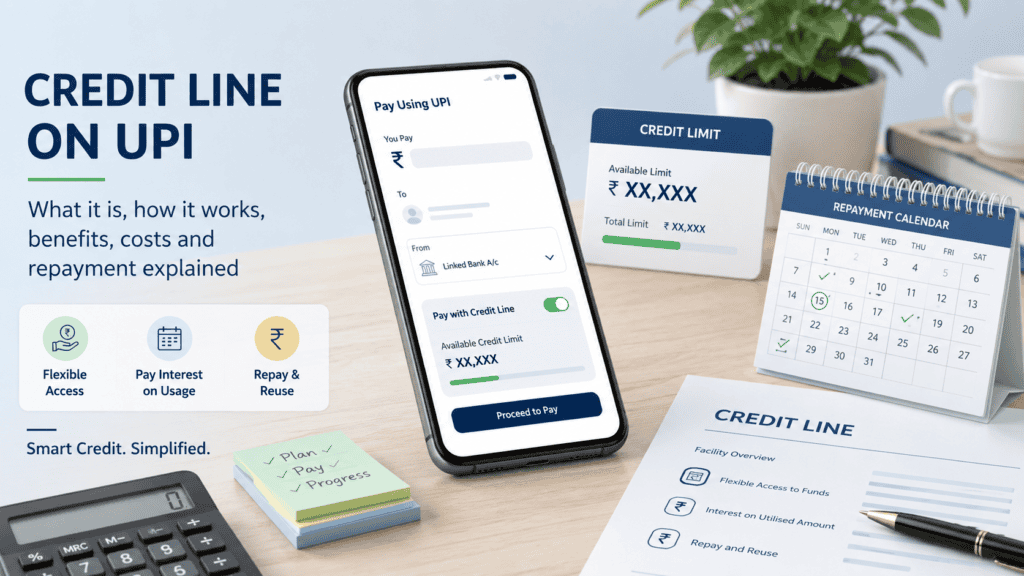
UPI is one of the most trusted payment habits in India — you scan, you pay, done. So when a “Credit Line on UPI” option appears inside your banking or UPI app, it looks like just another way to pay. It is not. A credit line on UPI changes the source of your payment from your own savings balance to bank-approved borrowed credit — and that changes everything about repayment, interest, fees, and your CIBIL score. Before you activate it or spend from it, you need to understand what it actually is, what it costs, and when it makes sense versus when it quietly becomes a debt problem. This guide covers all of that in plain language.
Quick Answer: What Is Credit Line on UPI?
Credit line on UPI is a bank-approved credit facility that lets eligible users make UPI payments from a pre-sanctioned limit instead of savings balance. It needs prior customer consent, bank-set terms, and repayment discipline. Check interest, fees, due date, merchant acceptance, and CIBIL impact before using it.
Key Takeaways
- Credit line on UPI uses bank-approved borrowed credit as the payment source — not your savings account balance. Every spend creates a repayment obligation, exactly like a credit card transaction.
- Approval, credit limit, interest rate, and repayment period are set by the bank under its own board-approved policy — there is no single national rate or universal limit that applies to everyone.
- Missed or delayed repayment may trigger interest charges, late fees, and a possible negative entry on your credit report with bureaus such as TransUnion CIBIL, Experian, CRIF High Mark, or Equifax.
- Before using it even once, verify the APR (Annual Percentage Rate), repayment due date, late fee, any processing or annual fee, and whether the facility reports to credit bureaus — all from your bank’s official app or website.
- Credit line on UPI is not the same as normal UPI, BNPL, or a RuPay credit card on UPI — each has a different funding source, repayment rule, and risk profile.
- Use it only for planned expenses where you are confident you can repay in full from next month’s income. If you are already stretched on EMIs or credit card dues, pause before activating.
Key Facts at a Glance
| Feature | Detail |
|---|---|
| Product type | Pre-sanctioned bank credit facility accessed via UPI |
| Regulatory framework | Enabled by RBI (rbi.org.in); NPCI (npci.org.in) operates the UPI ecosystem |
| Payment mode | UPI — scanned QR, UPI ID, or UPI-linked payment |
| Source of funds | Bank-approved credit limit (not your savings balance) |
| Prior consent required | Yes — customer must consent before the credit line is linked as a UPI funding account |
| Repayment | As per bank terms — billing cycle, due date, and repayment period set by the lender |
| Interest and fees | Vary by bank — verify APR, late fee, processing fee, and GST from your bank before use |
| Credit bureau reporting | May be reported to TransUnion CIBIL, Experian, CRIF High Mark, and Equifax — confirm with your bank |
| Who sets the credit limit | Your bank, based on its board-approved policy and your credit profile |
| Not the same as | Normal UPI (own money), RuPay credit card on UPI, BNPL, or personal loan |
What Is Credit Line on UPI — and How Is It Different from Normal UPI?
When you pay using normal UPI — whether through GPay, PhonePe, Paytm, or your bank’s app — the money moves from your own linked savings or current account. There is no loan, no borrowing, and no repayment obligation. The transaction ends the moment the payment succeeds.
Credit line on UPI works differently. Here, the bank has pre-sanctioned a credit limit for you — meaning it has already decided, based on your account history, credit profile, and internal policy, that it will lend you up to a certain amount. You then consent to link this credit limit as a funding account in your UPI app. When you make a UPI payment from this source, you are spending borrowed money. The merchant still receives their payment instantly, but you now owe the bank that amount — plus any applicable interest or fees — by the due date.
The term pre-sanctioned credit line means the bank has approved the credit facility in advance, before you spend. This does not mean the money is free, or that your limit is permanent, or that you are guaranteed this facility forever. The bank can revise, reduce, or withdraw the credit line based on its policy and your repayment behaviour.
A funding account in UPI is simply the source of money for a payment. Normally it is your savings account. With credit line on UPI, the credit limit becomes an additional funding account option — a borrowed pool you can dip into when you pay at eligible merchants.
According to RBI (rbi.org.in), banks that are members of the UPI payment system may allow pre-sanctioned credit lines at the bank to be linked as a funding account for UPI transactions, subject to prior customer consent and the bank’s board-approved policy. NPCI (npci.org.in) operates the UPI ecosystem and has enabled credit line on UPI as a product for participating banks and their customers.
The key practical point: every rupee you spend using a credit line on UPI is borrowed money. It must be repaid as per the bank’s repayment period. If it is not repaid on time, the bank may apply interest from the transaction date, add a late fee, and report the overdue to credit bureaus.
Step 1 — Bank approves or offers a credit limit
Your bank assesses your account history, credit score (from bureaus such as TransUnion CIBIL), income, existing obligations, and internal risk policy. If you meet its criteria, it may approve a credit line and notify you through the banking app or a communication.
Step 2 — You give consent and link the credit line in your UPI app
RBI’s framework requires explicit prior customer consent before the credit line can be linked as a UPI funding account. You cannot be automatically enrolled. You must actively agree, typically through the bank’s app or UPI app, for the facility to become usable.
Step 3 — You pay eligible merchants using UPI
Once linked, the credit line appears as a payment source option when you scan a QR code or initiate a UPI payment. You select it as the funding account. The merchant receives the payment from the bank’s credit pool — not your savings balance.
Step 4 — You repay the used amount by the due date
The bank generates a repayment schedule — similar in structure to a credit card billing cycle — with a due date and repayment amount. If you repay the full amount before the due date, the cost may be lower or zero depending on your bank’s terms. If you miss the due date or pay only part of the amount, interest and late fees apply, and the credit bureau may receive a report of the overdue.
Real Example: Rohan’s First Month with UPI Credit Line
Rohan is 29, works as a junior software analyst in Pune, and earns around ₹55,000 per month. He already uses UPI daily for groceries, fuel, and food delivery. In early March, he notices a “Credit Line” option in his bank’s app — the bank has pre-approved a ₹15,000 credit limit based on his account history.
Rohan has only ₹2,000 left in his account in the last week of the month. He decides to use the credit line to pay for ₹5,000 worth of monthly grocery and fuel bills, thinking it works like a normal UPI top-up.
If Rohan repays the ₹5,000 in full by the repayment due date the bank sets — and his bank offers an interest-free period for timely repayment — the cost of that ₹5,000 spend may be low. However, the exact repayment period, whether an interest-free period applies, and what charges arise if he misses the date all depend on his specific bank’s terms, which he must verify from the bank’s official app or website before spending.
If Rohan misses the due date, the bank may apply interest from the transaction date and add a late fee. It may also report the overdue to credit bureaus, which could lower Rohan’s credit score. The key insight: the ₹5,000 felt like a simple UPI scan, but it created a bank repayment obligation — not a charge from his own balance.
Eligibility and What the Bank Checks Before Approving a Credit Line
Credit line on UPI is not available to every UPI user by default. Eligibility depends entirely on the bank’s internal assessment and its board-approved policy. There is no single national eligibility standard that applies across all banks. Before expecting to use or activate this facility, verify the following from your bank’s official app, website, or branch:
- Bank account relationship: You generally need an active savings or current account with the bank offering the credit line. Not all banks have launched this facility.
- Bank’s internal credit assessment: The bank evaluates your account history, income, existing loan or EMI obligations, credit utilisation, and repayment track record.
- Credit bureau check: The bank may run a credit check using your credit report from bureaus such as TransUnion CIBIL (transunioncibil.com), Experian (experian.in), CRIF High Mark (crifhighmark.com), or Equifax (equifax.co.in). If this is a hard inquiry — a formal credit pull that appears on your credit report — it may have a small short-term impact on your score. Understand hard inquiry score effect before applying for any credit facility.
- KYC compliance: Your account must be KYC-complete with the bank. Partial or minimum KYC accounts are unlikely to be eligible.
- Customer consent: RBI requires prior customer consent before the credit line can be linked to UPI. You cannot be auto-enrolled without agreeing.
- App and merchant support: Not all UPI apps or merchants support credit line as a funding source. Check your specific app and bank combination for compatibility.
Specific income thresholds, minimum credit score requirements, and credit limit ranges vary by bank and change over time. Verify all eligibility criteria directly from your bank before assuming you will qualify or receive a specific limit.
How a ₹5,000 UPI Credit Line Spend Can Cost You More Than You Expect
The cost of using a credit line on UPI depends on whether you repay on time, how much you repay, and what your bank charges. Here are three scenarios using a ₹5,000 illustrative spend:
Interest cost (if applicable) = Outstanding amount × Monthly rate × Number of months outstanding
Where: Monthly rate = Annual rate ÷ 12 | Outstanding amount = amount not repaid by due date
| Scenario | What Happens | Estimated Cost |
|---|---|---|
| Scenario A — Full repayment by due date | You repay ₹5,000 in full before the bank’s repayment due date | May be low or nil if the bank offers an interest-free repayment period — verify from your bank’s terms |
| Scenario B — Delayed repayment (after due date) | You repay ₹5,000 one month after the due date. The bank applies interest from the transaction date or due date, plus a late fee | Interest rate and late fee vary by bank — verify before use. On illustrative 24% per annum for one month, ₹5,000 could attract approximately ₹100 in interest alone, plus late fee and applicable GST |
| Scenario C — EMI conversion (if offered by bank) | Bank offers to convert the ₹5,000 spend into 3 or 6 monthly EMIs at a stated interest rate | EMI amount, total interest, and any EMI conversion fee vary by bank — verify from your bank’s app or KFS document before converting |
Similar to how a credit card billing cycle works, the repayment period for a UPI credit line is set by the bank, and the cost of carrying a balance beyond the due date compounds quickly. Always check the total cost — principal plus interest plus fees — not just the EMI amount, before deciding to convert or delay.
Credit Line on UPI vs Normal UPI vs Credit Card: The Key Differences
This is where most borrowers get confused — and where the most costly mistakes happen. Understanding how card-based UPI payments differ from credit line on UPI and standard UPI payments will help you choose the right funding source for every transaction.
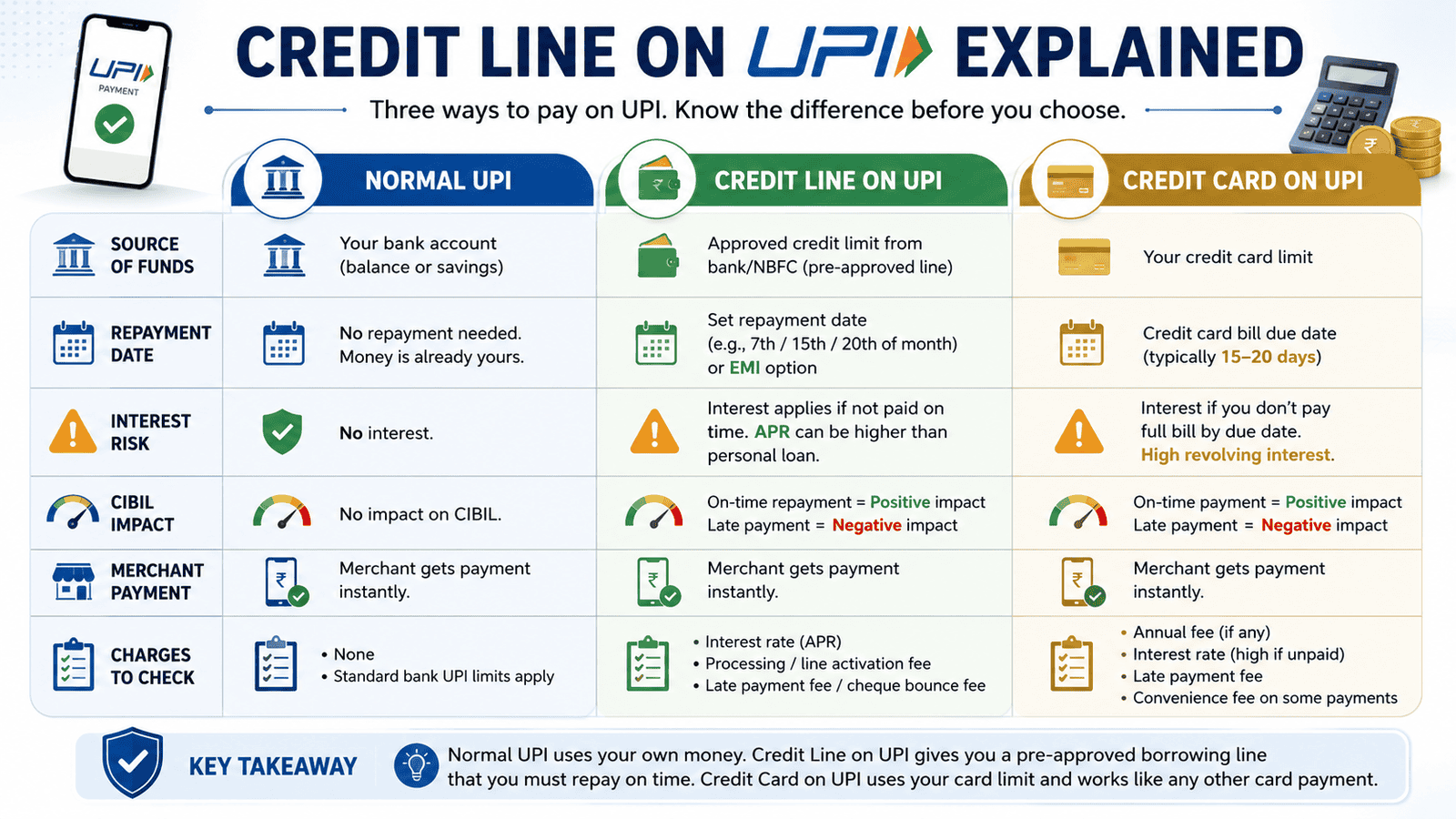
| Feature | Normal UPI | Credit Line on UPI | Credit Card on UPI (e.g. RuPay) |
|---|---|---|---|
| Source of funds | Your own savings/current account balance | Bank-approved credit limit (borrowed) | Credit card limit issued by card issuer |
| Repayment obligation | None — you spent your own money | Yes — repay by bank’s due date | Yes — repay by card statement due date |
| Interest risk | None | Interest applies if not repaid on time | Interest applies if full due not paid by due date |
| Late fee risk | None | Late fee applies on missed repayment | Late payment fee applies on missed card payment |
| Credit bureau impact | None | May be reported — confirm with bank | Yes — reported to all four credit bureaus |
| Credit limit | Not applicable — limited to your balance | Set by your bank based on its policy | Set by card issuer based on your credit profile |
| Merchant acceptance | All UPI merchants | Eligible UPI merchants — varies by bank and app | UPI merchants where RuPay credit card on UPI is supported |
| Prior consent required | No — savings account is default | Yes — explicit consent needed | Yes — card must be linked to UPI app |
| Who sets terms | Not applicable | Your bank under board-approved policy | Card issuer — governed by RBI credit card rules |
A RuPay credit card on UPI is a different product from credit line on UPI. With a RuPay credit card on UPI, you are spending from a standalone credit card account — with its own credit limit, statement date, grace period, and issuer terms — accessed through a UPI QR scan. With credit line on UPI, the credit is embedded inside your bank account relationship, not a separate card product. Both create repayment obligations, but the terms, charges, and reporting behaviours may differ significantly.
If Something Goes Wrong: Complaints and Next Steps
If you face a problem with a credit line on UPI transaction — a failed payment, a wrong debit, an activation error, or a disputed repayment charge — follow these steps:
Step 1 — Check the transaction status immediately
Open your bank’s app or UPI app and check whether the payment was successful, pending, or failed. Note the transaction ID, date, amount, and payment source.
Step 2 — Save all evidence
Take screenshots of the transaction status, payment confirmation, and any repayment charge or billing statement. These are essential for any dispute or complaint.
Step 3 — Raise a complaint with your bank’s grievance channel
Every bank must have a formal grievance redressal mechanism. Contact customer care using the official number or email listed on your bank’s website. Submit your complaint in writing, with your transaction ID and supporting screenshots. Note the complaint reference number for follow-up.
Step 4 — Escalate if unresolved
If the bank does not resolve your complaint within the timeline stated in its grievance policy, you may escalate to the RBI Integrated Ombudsman Scheme at rbi.org.in. For UPI-specific disputes, NPCI at npci.org.in also maintains grievance channels. Do not rely solely on app chat support for disputed repayment charges — follow the formal written complaint route for a reliable record.
Borrower Safety Checklist Before Activating Credit Line on UPI
Before you activate or spend even ₹1 using a credit line on UPI, go through this checklist using only your bank’s official app, website, or a printed Key Fact Statement (KFS) if the bank provides one:
| Checkpoint | Why It Matters |
|---|---|
| What is the interest rate (APR)? | APR shows the true annual cost of borrowing. A monthly rate that looks low may translate to 24–36% per annum — verify the exact figure from your bank |
| Is there an interest-free period? | Some banks may offer a grace period before interest applies — but this is not guaranteed. Do not assume it exists unless stated explicitly in your bank’s terms |
| What is the repayment due date? | Missing the due date triggers interest and late fees — and may affect your credit score |
| What is the late fee? | Late fees vary by bank and are charged as a fixed amount or percentage — verify from your bank |
| Is there a processing or annual/renewal fee? | Some banks charge an upfront fee or yearly renewal fee — check the KFS or product terms before activating |
| Does GST apply to fees? | GST at 18% typically applies to financial service charges including late fees and processing fees — factor this into your cost estimate |
| Does the bank report usage to credit bureaus? | If reported, your credit utilisation and repayment behaviour will appear on your credit report at bureaus such as TransUnion CIBIL (transunioncibil.com) — confirm with your bank |
| Is there an autopay or e-mandate? | Some banks may set up an auto-debit for repayment — check whether this is active and whether your account will have sufficient balance on the debit date |
| Which merchants and apps support it? | Not all UPI merchants or all UPI apps support credit line as a funding source — verify compatibility before relying on it |
The consequences of a missed repayment on a credit facility can be significant and long-lasting. Read about late payment credit impact to understand how delayed repayment — whether on a credit card or a UPI credit line — can affect your CIBIL score and future loan eligibility.
How to Decide What’s Right for You
Credit line on UPI may work well in some situations and create problems in others. Use these decision rules — adapted for your actual income, repayment discipline, and existing financial obligations — before activating or spending:
you have a one-time cash-flow timing gap — for example, your salary is due in five days but you need to pay for an essential expense now — and you are confident you can repay the full amount from your next salary: credit line on UPI may be a convenient short-term bridge.
you understand the repayment due date, the APR, and any late fee clearly — and you have verified all charges from your bank’s official terms: using the facility for a planned, budgeted expense may be reasonable.
you are already paying minimum due on a credit card or have high existing EMI obligations: adding another credit line increases your total debt load and the risk of a missed payment — consider clearing existing dues first.
you are using the credit line every month because your income does not stretch far enough: this is a sign of structural cash-flow stress, not a temporary gap — a recurring credit line spend with uncertain repayment can become a debt spiral faster than most borrowers expect.
you are unsure about the interest rate, due date, or fees: do not spend first and check later — check first, spend only if it is affordable. Once you have used the credit, the repayment obligation exists regardless of whether you understood the terms.
you can clearly answer “what is my repayment due date, what is the total I will owe, and will I have that money available?”: do not activate or use the credit line yet. Get the answers from your bank’s official app or KFS first. Explore the full comparison of UPI credit versus card options before deciding.
| Situation | Use / Avoid / Recheck | Safer Next Step |
|---|---|---|
| One-time essential expense, salary due in days, full repayment certain | May Use | Confirm due date and repayment amount from bank app before spending |
| Charges unclear, APR not checked, terms not read | Recheck First | Read the KFS or product terms in the bank app before activating |
| Already carrying credit card minimum due or high EMI burden | Avoid for Now | Clear existing dues before adding a new credit line |
| Monthly spending shortfall — relying on credit every month | Avoid | Review monthly budget; consider income-side solutions before borrowing |
| Discretionary spending — dining out, entertainment, shopping | Avoid | Use own savings balance; borrow only for planned, necessary expenses |
When This May Not Be the Right Choice
Credit line on UPI may not be suitable in these situations — and if any of these apply to your situation, it may be worth exploring other options before committing:
- Irregular income or unpredictable salary date: If you cannot reliably predict when you will have money available to repay, a credit facility with a fixed due date creates a high risk of a missed payment and its consequences.
- Already paying only the minimum due on one or more credit cards: This is a signal that your current credit burden already exceeds comfortable repayment capacity. Adding another credit line will increase interest cost and credit utilisation simultaneously.
- You have not read or understood the interest rate, APR, or late fee: Using credit without understanding what it costs is one of the most common ways ordinary borrowers end up in avoidable debt. The terms are your responsibility to check — from the official bank source, before the first spend.
- You plan to use it mainly for discretionary or lifestyle spending: Borrowing for routine lifestyle expenses — food delivery, subscriptions, entertainment — without a clear repayment plan creates a cycle of small debts that compound faster than most people expect.
- You are using credit to pay off other credit: Using a UPI credit line to clear credit card dues or another loan, without a structured repayment plan, typically increases total debt cost rather than reducing it.
Official Rules and Where to Verify
Credit line on UPI is a regulated product, and the rules that govern it come from RBI and NPCI — not from app marketing descriptions or third-party articles. Verify all of the following from official sources before activating or using the facility:
- RBI — rbi.org.in: The Reserve Bank of India has enabled pre-sanctioned credit lines at banks through UPI, subject to prior customer consent and banks’ board-approved policies. RBI sets the regulatory framework under which banks may offer this facility. The RBI website is the authoritative source for regulatory rules, including any updates to how credit lines through UPI are permitted, restricted, or governed.
- NPCI — npci.org.in: The National Payments Corporation of India operates the UPI ecosystem and maintains the Credit Line on UPI product framework. NPCI’s website contains product-level information about how credit lines are enabled as UPI funding accounts, and which participant categories can offer the facility.
- Your bank’s official app or website: This is the only source for your specific credit limit, APR, interest rate, repayment period, due date, late fee, processing or annual fee, GST implications, credit bureau reporting, and grievance process. Do not rely on third-party calculators or comparison sites for these figures — they can be outdated or inaccurate for your specific bank.
- Credit bureaus — TransUnion CIBIL (transunioncibil.com), Experian (experian.in), CRIF High Mark (crifhighmark.com), Equifax (equifax.co.in): These bureaus maintain your credit report. If a credit line on UPI is reported, your repayment behaviour and credit utilisation will appear in your report. Check your credit report from any of these bureaus periodically to verify what is being reported about your UPI credit activity.
Rules, fees, interest rates, billing terms, and eligibility conditions can change by bank and with RBI policy updates. Always verify current fees, interest rates, billing rules, and reward terms from the card issuer and official regulatory sources before applying or using a credit card feature.
Common Mistakes to Avoid
Treating it as free UPI money
The most dangerous misunderstanding about credit line on UPI is assuming that because the payment interface looks identical to normal UPI, the money is coming from your own account. It is not. Every spend from a credit line creates a debt. If you scan and pay ₹3,000 for groceries using the credit line, you now owe ₹3,000 to the bank — plus possible interest and fees if not repaid on time.
Before every credit line spend, consciously remind yourself: this is borrowed money, not my balance.
Ignoring the repayment due date
Many borrowers activate the facility, spend from it, and then forget that there is a hard repayment deadline. Missing the due date — even by a day — can trigger late fees and interest. On a ₹10,000 spend at an illustrative 24% annual rate, one month’s delay could cost approximately ₹200 in interest alone, plus late fee and GST. Check the exact due date from your bank’s app immediately after every spend.
Not checking the APR before activating
The interest rate on a credit line may be stated as a monthly rate — for example, 2% per month. That translates to approximately 24% per year. Some facilities may charge more. Always ask for and verify the APR (Annual Percentage Rate), not just the monthly rate, to understand the full cost of borrowing.
Using the full available credit limit
Just because a bank has approved a ₹20,000 credit line does not mean you should spend ₹20,000. High credit utilisation on a revolving credit facility can negatively affect your credit score and leave you with a large repayment obligation that is harder to clear in one cycle. Use only what you are confident you can repay in full by the due date.
Assuming all merchants and UPI apps support it
Credit line on UPI is not universally available at every merchant or on every UPI app. Merchant support, app compatibility, and bank participation all vary. Do not count on the credit line being available in a payment situation before verifying that your bank, app, and merchant combination supports it.
Not checking whether the bank runs a hard credit inquiry on activation
Some banks may perform a formal credit check when you apply for or activate a credit line. A hard inquiry appears on your credit report and can marginally lower your credit score in the short term. If you are planning to apply for a home loan or personal loan soon, check with your bank whether the credit line activation involves a hard pull before proceeding.
Forgetting that credit bureau reporting means your repayment history is permanent
If the bank reports your credit line usage to TransUnion CIBIL, Experian, CRIF High Mark, or Equifax, every missed or late repayment becomes part of your credit history. A single missed payment on a credit facility can reduce your CIBIL score by a significant number of points and remain visible on your credit report for years. Treat every repayment deadline as seriously as an EMI due date.
Expert Tips
- Read the Key Fact Statement (KFS) before activating: If your bank provides a KFS for the credit line product, read it in full before consent. It must state the APR, fees, repayment schedule, and borrower rights in plain language — this is your clearest source of verified cost information.
- Set a calendar reminder for the repayment due date immediately after each spend: Do not rely on the bank’s app notification alone. Set a reminder two to three days before the due date so you have time to arrange the repayment amount even if salary is slightly delayed.
- Check your credit report at least once a quarter: After activating a credit line on UPI, verify with bureaus such as TransUnion CIBIL (transunioncibil.com) that your repayment behaviour is being reported accurately. Errors in credit reports can damage your score even if you repaid correctly.
- Treat the credit line like a credit card, not like a wallet top-up: The discipline for using a credit line on UPI is identical to credit card discipline — spend only what you can repay in full by the due date, never roll over balances unless you have factored in the full interest cost.
- Compare the total cost with a small personal loan before using the credit line for larger spends: For a spend above ₹10,000–₹15,000, a personal loan from an RBI-registered bank or NBFC may offer a lower effective rate than a revolving credit line with high interest if you cannot repay within the billing period — compare APRs before deciding.
- Do not activate the facility simply because the bank offered it: A bank offering you a credit line is in its commercial interest. Whether using it is in your interest depends on your repayment capacity, existing obligations, and whether you have read the terms — evaluate it independently, not on the basis of convenience or bank encouragement.
Frequently Asked Questions
Is credit line on UPI a loan?
It is a credit facility — functionally similar to a loan or credit card in that you borrow money from the bank and must repay it. It is not a personal loan with a fixed disbursement and fixed EMI schedule, but it creates a repayment obligation with interest and fees if not repaid by the due date. Treat it as borrowed money, not free payment access.
Who is eligible for credit line on UPI?
Eligibility depends on your bank’s internal policy, your account history, credit profile (assessed using bureaus such as TransUnion CIBIL), income, and existing obligations. There is no single universal eligibility criterion across banks. Check directly with your bank’s app or website — do not assume you qualify simply because you have a UPI-linked account.
Does credit line on UPI affect my CIBIL score?
It may. If the bank reports your credit line usage to credit bureaus, your credit utilisation and repayment history will appear in your credit report at TransUnion CIBIL and potentially other bureaus. A missed or late repayment is likely to be reported as an adverse entry, which can lower your credit score. Confirm with your bank whether the facility is reported, and to which bureaus.
Is credit line on UPI better than a credit card?
That depends on your bank’s specific terms, the APR, repayment period, fees, and your usage pattern. Neither can be called definitively better without comparing the actual terms your bank offers against your existing credit card’s terms. Note that fees, rewards, eligibility, interest, and repayment rules can change — verify both products’ current terms before deciding. You can also explore a detailed comparison of UPI credit versus card options to help your decision.
Do I pay interest on every UPI credit line transaction?
Not necessarily — some banks may offer an interest-free repayment period if you repay the full amount before the due date. However, this is not universal. Whether an interest-free period exists, how long it lasts, and what happens if you miss it are all bank-specific terms. Verify from your bank’s official documentation before assuming interest will not apply.
Can I use credit line on UPI for all UPI payments?
No. Merchant acceptance and app support vary by bank and by UPI app. Some transactions — such as peer-to-peer transfers (paying a person’s UPI ID directly) — may not be eligible. Check your bank’s terms and app compatibility for the specific payment type you intend to make before relying on the credit line.
What happens if I miss repayment on a UPI credit line?
The bank may apply interest from the transaction date or the due date (check which applies in your bank’s terms), add a late fee, apply GST on charges, and report the overdue to credit bureaus. This can reduce your CIBIL score and affect your eligibility for future credit. In repeated non-payment situations, the bank may also reduce or withdraw the credit limit. Read about late payment credit impact to understand the full consequences.
Should first-time borrowers activate credit line on UPI?
A first-time borrower — someone with limited credit history — should approach any new credit facility with extra care. If you activate and use a credit line on UPI and repay it perfectly, it may help build a positive credit history. If you miss a repayment, the negative entry could affect your ability to get other credit products for years. First-time borrowers should activate only if they have read all the terms, are confident about repayment, and have set up a repayment reminder before the first spend.
Final Verdict
Credit line on UPI is a legitimate, RBI-enabled credit facility — not free UPI money and not guaranteed to every user. It may be genuinely useful for a salaried borrower with a short cash-flow timing gap who understands the repayment due date, APR, and charges, and can repay the full amount from next month’s income without stress. It can become a quiet but costly problem if treated like a wallet balance, used for lifestyle overspending, or activated without reading the bank’s terms. Before activating, read the KFS or product document in your bank’s app, note the exact repayment due date, calculate the total cost if you delay repayment, and check whether the facility reports to credit bureaus. If you are already carrying credit card dues or high EMI obligations, pause before adding another credit line. The credit line on UPI is a tool — useful in the right hands, risky in the wrong habit. Always verify the latest fees, interest rates, billing rules, and reward terms from the card issuer and official regulatory sources before applying or using a credit card feature.
This article is for educational purposes only and should not be treated as personalised financial, credit, or legal advice. Credit card fees, interest rates, billing rules, eligibility criteria, rewards, and issuer terms can vary and may change over time. Please verify current terms directly with the card issuer, official regulatory source, or a qualified professional before applying for or using any credit card feature.

Meera Nair writes practical credit card guides for Indian users, focusing on eligibility, fees, billing cycles, reward value, UPI credit cards, EMI conversion, CIBIL impact, fraud protection, and safer card usage. She explains card decisions in simple language without pushing readers toward risky borrowing.