
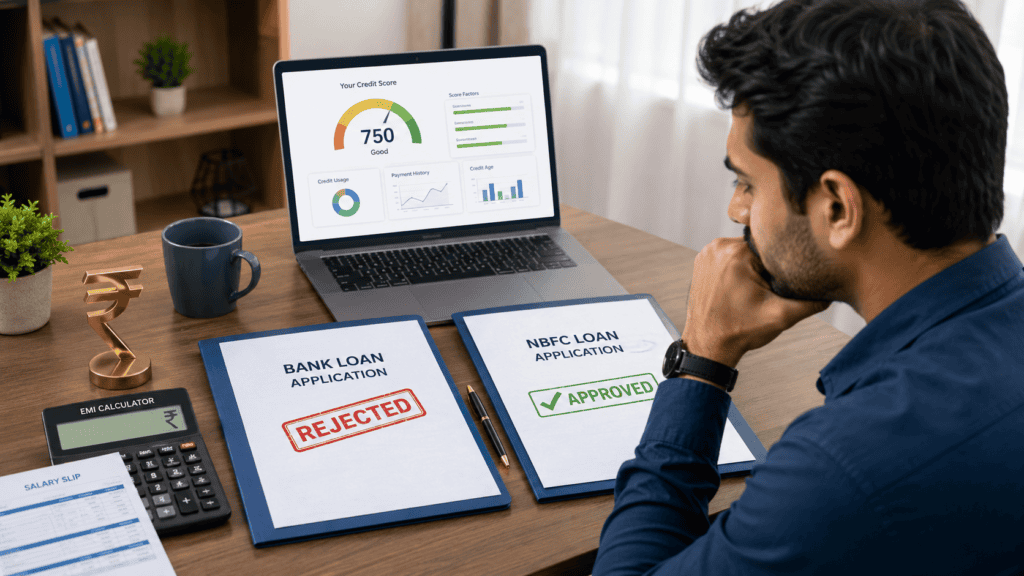
Your bank said no. An NBFC said yes. Now you’re staring at two decisions — and you’re not sure which one to trust. This is one of the most common and confusing loan situations in India, and it happens far more often than most borrowers realise. A bank rejection does not mean you cannot borrow. But an NBFC approval does not automatically mean you should. The two lenders are using different risk rules, different income filters, and different cost structures — and understanding that difference is the only way to make a smart choice. This article explains exactly why NBFC approved but bank rejected your loan, what that tells you about your credit and income profile, what the NBFC offer may actually cost you, and what you should check before signing anything.
Quick Answer: Why NBFC Approved But Bank Rejected Loan
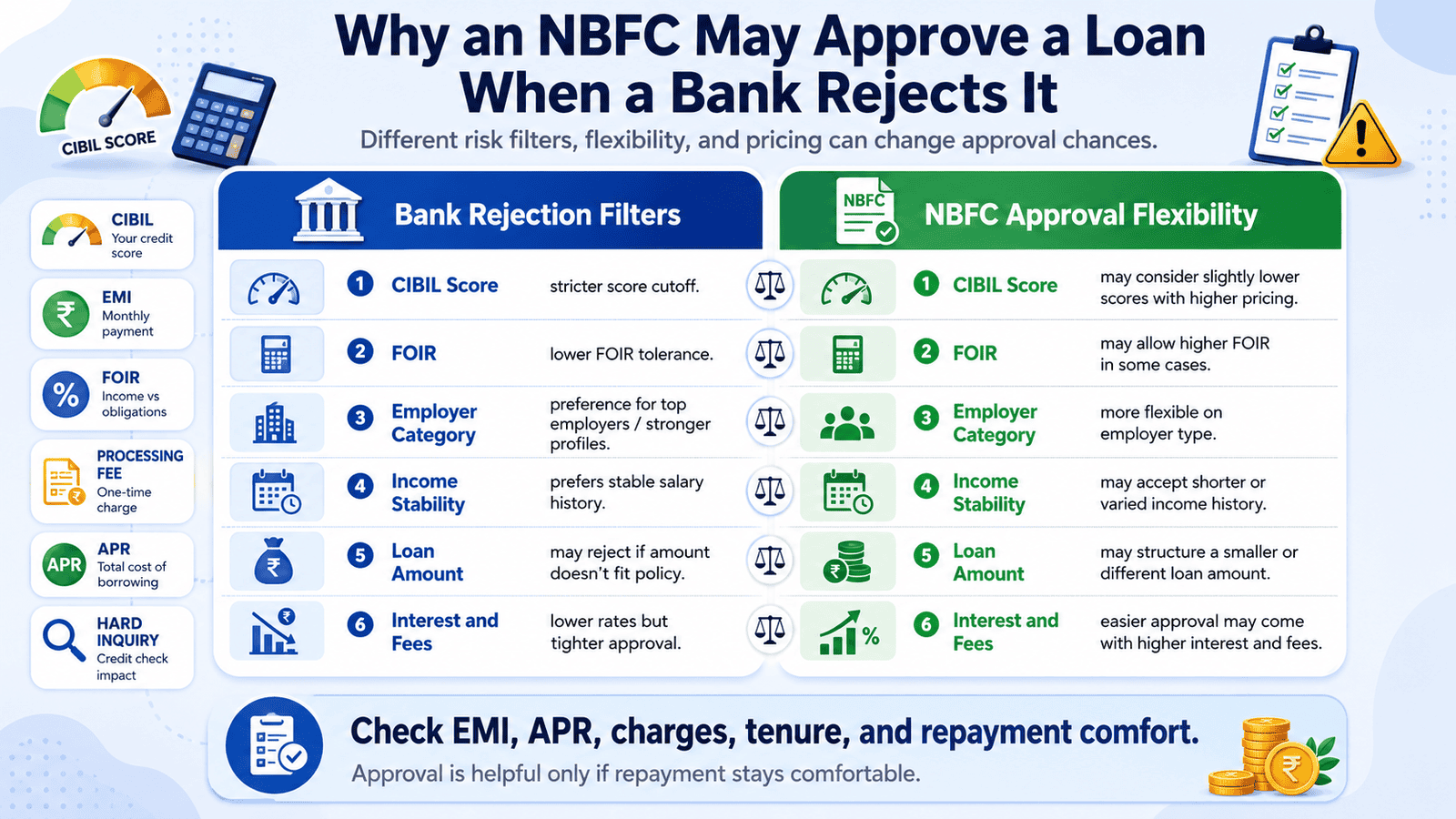
Why NBFC approved but bank rejected loan usually comes down to different risk rules. Banks may apply stricter filters for CIBIL score, FOIR, employer category, salary stability, and internal policy, while NBFCs may approve the same borrower at a higher cost, smaller amount, or tighter repayment terms.
What to Do Right Now — Before Accepting the NBFC Offer
Before you sign anything or transfer a single rupee of processing fee, run through these five steps.
Step 1 — Ask the bank for the broad reason, if they share it
Banks are not required to give you a detailed breakdown, but they may share a broad category — low CIBIL score, high FOIR, employer category mismatch. Even a vague reason helps you understand what to fix.
Step 2 — Read the NBFC offer letter carefully
Look for the interest rate (and whether it is flat or reducing-balance), the APR, the processing fee, EMI amount, tenure, foreclosure charges, and whether any insurance product has been bundled in.
Step 3 — Check your credit report before anything else
Get your credit report from TransUnion CIBIL (transunioncibil.com), Experian India (experian.in), or CRIF High Mark (crifhighmark.com). Look for overdue accounts, settled or written-off accounts, or any entry you do not recognise. Errors on a credit report can cause rejections and should be raised with the bureau directly.
Step 4 — Calculate your EMI affordability honestly
Add up your rent, household expenses, existing EMIs, and the proposed new EMI. If the total leaves you with less than a month’s emergency buffer, the loan may not be affordable regardless of who approved it.
Step 5 — Avoid applying to more lenders right now
Every new loan application triggers a hard inquiry on your credit report. Multiple hard inquiries in a short window can reduce your credit score and further lower your chances of approval elsewhere. Read more about multiple loan applications and CIBIL score impact before submitting another form.
Key Takeaways
- Banks and NBFCs use different underwriting models — one lender’s rejection does not mean every lender will reject the same application.
- NBFC approval often comes with risk-based pricing: a higher interest rate, smaller approved amount, or shorter tenure compared to what a bank might offer the same borrower.
- Bank rejection is commonly linked to CIBIL score below the bank’s internal comfort level, FOIR above their threshold, employer category mismatch, or salary below their minimum cut-off — all of which may be acceptable to an NBFC at a higher price.
- On a ₹3 lakh loan, the difference between an 11% and an 18% annual interest rate over three years translates to roughly ₹12,000–₹15,000 in additional total interest — a real cost, not a small rounding difference (illustrative; verify actual rates with the lender).
- Do not accept the NBFC loan only because it was approved. Compare total repayment cost, check EMI affordability, and verify all charges before signing.
- A bank rejection may be fixable. Reducing existing EMIs, correcting credit report errors, or waiting for your credit score to improve can open the door to a bank loan at a lower cost later.
Key Facts at a Glance
| Term | What It Means | Borrower Implication |
|---|---|---|
| Bank rejection | The bank’s internal filters — CIBIL, FOIR, income, employer — did not clear your profile | Not a permanent verdict; may be fixable |
| NBFC approval | The NBFC’s more flexible model cleared your profile, often by pricing the risk higher | Check cost carefully before accepting |
| CIBIL score | A three-digit credit score (300–900) calculated from your repayment history by TransUnion CIBIL and other bureaus | Bureaus vary; get your report and check for errors |
| FOIR | Fixed Obligations to Income Ratio — the percentage of your monthly income already going toward EMIs | Many banks prefer FOIR below 40–50%; verify the specific lender’s threshold |
| Risk-based pricing | A lender charges a higher interest rate when it perceives higher borrower risk | NBFC approval at a high rate may cost significantly more than a bank loan |
| Hard inquiry | A credit check made by a lender when you apply; recorded on your credit report | Multiple applications in a short period can lower your score |
For a full breakdown of income, CIBIL, and document requirements behind loan decisions, see eligibility rules explained.
Why an NBFC Approved Your Loan When the Bank Did Not
Banks and NBFCs are both regulated lenders under the Reserve Bank of India (rbi.org.in), but they operate under different regulatory frameworks and apply different internal risk filters. A bank that rejects your application is not saying you are untrustworthy — it is saying your profile does not clear its particular combination of score, income, employer, and internal policy thresholds on that day.
How bank underwriting typically works
Most banks use tightly calibrated internal models that weigh CIBIL score, Fixed Obligations to Income Ratio (FOIR), employer category, salary amount, years at current employer, banking behaviour, and existing debt. Each filter has a threshold. If your profile misses even one of them — say your CIBIL score is 680 when the bank’s internal floor is 700, or your FOIR reaches 52% when the bank prefers it below 50% — your application may be declined regardless of your other strengths.
How NBFC underwriting may differ
NBFCs may use broader approval criteria. Many are willing to assess borrowers with lower credit scores, non-salaried or semi-formal income, employer categories that banks deprioritise, or shorter employment histories. Some NBFCs use alternate data signals — banking transaction patterns, utility bill regularity, or digital footprint — to assess repayability alongside formal income documents. This broader assessment is not charity; it is risk-based pricing. The NBFC compensates for a higher-risk borrower profile by offering a higher interest rate, a smaller loan amount, a shorter tenure, or more restrictive foreclosure terms.
Common reasons a bank rejects but an NBFC may approve
For a wider list of why personal loan applications fail across lenders, see common rejection reasons.
| Possible Reason | What It Means | Possible Next Step |
|---|---|---|
| CIBIL score below bank’s floor | Score may be in the 600–720 range; bank comfort varies but many prefer 720+ | Check bureau report; correct errors; build repayment history |
| High FOIR | Existing EMIs already consume 45–55% or more of monthly income | Close one loan or credit card before reapplying |
| Employer category mismatch | Bank may not lend freely to certain private sectors, smaller firms, or contract employees | Check if lender has a preferred employer list or apply to an NBFC that assesses income differently |
| Salary below bank cut-off | Bank may have a higher minimum income threshold for unsecured loans | Consider a smaller loan amount or an NBFC with a lower income floor |
| Thin credit file | Too few credit accounts or too short a credit history for the bank’s model to assess confidently | Use a secured credit card or small loan to build history over 6–12 months |
| Recent hard inquiries | Multiple recent applications make the borrower look credit-hungry | Pause applications for 3–6 months; apply only to one lender at a time |
| Bank statement mismatch | Salary credits are irregular, there are frequent bounces, or inflows do not match declared income | Ensure salary is credited regularly and minimise bounced payments for 3 months before reapplying |
Real Example: Rohit’s Bank Rejection and NBFC Approval
Rohit, 31, is a software support executive in Pune earning a net monthly salary of ₹50,000 (illustrative figure; verify current income eligibility thresholds with the lender). He has an existing car loan EMI of ₹12,000 per month. He applied to his primary bank for a ₹3 lakh personal loan.
The bank calculated his FOIR before the new EMI: ₹12,000 ÷ ₹50,000 = 24%. So far, that is comfortable. But the proposed new personal loan EMI of ₹8,000 would push total EMIs to ₹20,000, resulting in a FOIR of 40%. The bank’s internal policy for his employer category may require FOIR to stay below 40%, or his CIBIL score of 695 may have fallen just below their internal floor of 700. The application was declined.
An NBFC with a wider credit model reviewed the same profile and approved ₹2.5 lakh instead of ₹3 lakh — at a higher interest rate and with a processing fee attached. The approval is real, but the loan is not identical to what the bank would have offered. Rohit now needs to compare the total repayment cost of the NBFC offer against the option of waiting three to six months, paying down his car loan slightly, and reapplying to the bank or another lender at a better rate.
The key insight: NBFC approval confirmed that Rohit’s income and repayment capacity are not zero — but it also reflected a higher risk price. He is not stuck, and he is not safe until he runs the numbers.
What Lenders Commonly Check Before Approving a Personal Loan
According to TransUnion CIBIL (transunioncibil.com), your credit report is one of the primary inputs into any lender’s approval decision. But it is not the only one.
| Eligibility Factor | Banks May Check | NBFCs May Check |
|---|---|---|
| Age | Typically 21–60 years; verify with lender | May be slightly wider; verify with lender |
| Monthly income | Minimum varies widely; many banks set higher floors for metro borrowers | May accept lower income; varies by NBFC |
| Employment type | Salaried preferred; stable employer category important | May accept semi-formal, self-employed, or contract employees depending on their model |
| CIBIL / credit score | Generally prefer 700+ or higher; bureau thresholds vary by bank | May approve lower scores at higher interest; varies |
| FOIR | Often prefer total EMI burden below 40–50% of income; verify with lender | May accept slightly higher FOIR with pricing adjustment |
| Bank statement conduct | Regular salary credits, low bounce rate, steady average balance | May also review digital transactions and alternate income signals |
| KYC and documents | PAN, Aadhaar, salary slips, bank statements typically required | Similar; some digital NBFCs use e-KYC and fewer paper documents |
How FOIR Explains the Rejection — With Numbers
FOIR — Fixed Obligations to Income Ratio — is the most important number most Indian borrowers have never heard of.
FOIR = (Total Monthly EMI Obligations ÷ Net Monthly Income) × 100
Where: Total Monthly EMI Obligations = all existing EMIs + proposed new EMI | Net Monthly Income = take-home salary after tax deductions
| Scenario | Monthly Income | Existing EMI | Proposed New EMI | Total EMI | FOIR |
|---|---|---|---|---|---|
| Before new loan | ₹50,000 | ₹12,000 | — | ₹12,000 | 24% |
| After new ₹3L loan (illustrative) | ₹50,000 | ₹12,000 | ₹8,000 | ₹20,000 | 40% |
| After new ₹2.5L loan (NBFC offer, illustrative) | ₹50,000 | ₹12,000 | ₹7,200 | ₹19,200 | 38.4% |
All figures above are illustrative. Actual EMI depends on interest rate and tenure, which vary by lender and borrower profile. Lender comfort levels for FOIR vary — some banks prefer below 40%, others allow up to 50% for high-income borrowers. Verify the current FOIR threshold with your specific lender.
Now look at the total repayment cost difference between a bank rate and an NBFC rate on the same ₹3 lakh loan (illustrative rates — verify with the lender before accepting):
| Loan Scenario | Amount | Rate (Illustrative) | Tenure | Approx. EMI | Total Repayment | Total Interest |
|---|---|---|---|---|---|---|
| Bank loan (if approved) | ₹3,00,000 | 11% p.a. reducing | 36 months | ₹9,821 | ₹3,53,556 | ₹53,556 |
| NBFC loan | ₹3,00,000 | 18% p.a. reducing | 36 months | ₹10,843 | ₹3,90,348 | ₹90,348 |
| NBFC loan (smaller amount) | ₹2,50,000 | 18% p.a. reducing | 36 months | ₹9,036 | ₹3,25,290 | ₹75,290 |
The difference between an 11% bank rate and an 18% NBFC rate on ₹3 lakh over three years is approximately ₹36,792 in additional interest — not a rounding error. All figures are illustrative. Verify the actual rate, processing fee, and total repayment figure from your specific NBFC offer letter before accepting. For a deeper look at what drives existing EMI burden in rejection decisions, see the linked guide.
Bank vs NBFC Loan Approval: A Side-by-Side Comparison
Both banks and NBFCs are regulated by the Reserve Bank of India (rbi.org.in), but their approval criteria, risk appetite, and cost structures differ meaningfully. For a full comparison of which type of lender suits different borrower profiles, read our guide on bank and NBFC comparison.
| Factor | Bank | NBFC |
|---|---|---|
| CIBIL score flexibility | More Strict Generally prefer 700+ or higher | More Flexible May approve lower scores at higher cost |
| FOIR tolerance | Tighter Many prefer FOIR below 40–50% | Wider May allow higher FOIR with pricing adjustment |
| Employer category | Selective Prefer listed, government, or large private employers | Broader May accept smaller firms or self-employed |
| Interest rate | Lower Generally lower for qualifying borrowers | Higher Risk-based pricing means higher rates for many profiles |
| Processing speed | Slower More documentation and verification | Faster Digital NBFCs often approve quickly |
| Borrower risk | Lower cost risk If approved, terms are usually more borrower-friendly | Cost risk Higher rate, fees, or strict foreclosure terms possible |
Your Five-Step Action Path After Bank Rejection
Step 1 — Understand the rejection reason
Banks may not disclose all internal reasons, but some will share a broad category — credit score, income, or employer. Ask politely. Any information helps.
Step 2 — Pull your credit report from a bureau
TransUnion CIBIL (transunioncibil.com), Experian India (experian.in), and CRIF High Mark (crifhighmark.com) all provide credit reports. Credit scores can vary between bureaus because not all lenders report to all four bureaus. Check at least one and review for errors, overdue accounts, or unexpected entries. Raise disputes for inaccuracies directly with the relevant bureau.
Step 3 — Calculate your FOIR using the formula above
Know your EMI burden number before you apply anywhere else. Use the formula and the NBFC’s proposed EMI to check whether the new total burden is realistic. For a plain-language explanation of how FOIR explained simply drives lender decisions, see the linked article.
Step 4 — Compare the NBFC offer cost fully
Do not compare only the EMI. Compare interest rate (confirm reducing-balance or flat), APR, processing fee, insurance bundling, foreclosure charge, and late payment penalty. Get the total repayment figure in writing from the NBFC offer letter.
Step 5 — Decide deliberately — accept, reduce amount, or wait
If the purpose is urgent and the EMI is affordable with a reasonable buffer, accepting the NBFC offer may be sensible. If the interest or fees are unclear, or if the EMI would stretch your monthly budget thin, it is worth pausing to explore alternatives — a smaller loan amount, a different NBFC, or a secured borrowing option if appropriate.
Safety Checklist Before Accepting the NBFC Loan
- Interest rate type confirmed: Is the rate reducing-balance or flat? A flat rate of 12% is not the same as a 12% reducing rate — the effective cost is significantly higher on a flat basis.
- APR reviewed: The Annual Percentage Rate includes interest plus fees. This is the true cost of the loan — not the headline rate.
- Processing fee verified: Processing fees vary; confirm the exact rupee amount and whether it is deducted upfront from the disbursed amount or added to the loan.
- Insurance bundling checked: Some lenders bundle a loan insurance product that adds cost. You are not obligated to buy insurance as a condition for the loan under RBI’s Fair Practices Code (rbi.org.in).
- Foreclosure charges confirmed: Understand what it costs to repay the loan early — this matters if your income improves later.
- Late payment charges understood: Know the penalty for missing or delaying an EMI before you sign.
- Lender identity verified: Confirm the NBFC is registered with the Reserve Bank of India (rbi.org.in). You can check NBFC registration status via the RBI website.
- Emergency buffer preserved: After all EMIs, rent, and household expenses, you should retain at least one month’s expenses as liquid buffer. If the new EMI eliminates this, the loan may not be affordable.
How to Decide What’s Right for You
the loan purpose is urgent and necessary (medical, education, essential repair) AND the total EMI burden including the new EMI stays below 45% of your monthly income — accepting the NBFC offer at a verified rate and with full charge disclosure may be a reasonable short-term step.
the NBFC rate, APR, processing fee, or foreclosure charges are not clearly stated in writing — do not sign until you have a complete offer letter with all cost items specified.
the bank rejected due to high FOIR and you have any existing loan that is near completion — waiting 2–3 months until that EMI closes may reduce your FOIR enough to reapply and qualify at a lower bank rate.
the bank rejected due to a CIBIL score slightly below their threshold and your credit report shows no overdue accounts — 3–6 months of clean repayment on existing obligations may be enough to lift your score into a more comfortable approval range.
the loan purpose is non-urgent (discretionary travel, gadget purchase, lifestyle upgrade) — wait, reduce costs from savings, and reapply later at better terms. A high-cost NBFC loan for a non-essential expense is rarely worth the added interest burden.
you cannot clearly answer “why do I need this loan” and “can I repay this EMI for the full tenure without missing a month” — then do not accept any loan offer at any rate until those two questions have clear answers.
Common Mistakes to Avoid
Applying to multiple lenders at once after rejection
Each application triggers a hard inquiry on your credit report, recorded by TransUnion CIBIL and other bureaus. Several hard inquiries in a short period signal credit-seeking behaviour and can reduce your score, making the next approval harder, not easier. Apply to one lender at a time after careful research. See multiple loan applications and CIBIL score impact for a full explanation.
Comparing only EMI, ignoring total repayment cost
A lower EMI can hide a higher interest rate if the tenure is longer. An NBFC offering ₹8,000 EMI over 48 months may cost you more in total than a bank offering ₹10,000 EMI over 30 months. Always compare the total repayment amount (principal + total interest + fees), not just the monthly number.
Assuming NBFC approval means your credit profile is healthy
NBFC approval at a high rate means the lender accepted your risk at a price. It does not mean your CIBIL score, FOIR, or credit report is in good shape. Check your credit report regardless of whether you accept the NBFC offer.
Accepting a loan bundled with insurance you did not ask for
Some lenders include a loan protection insurance product and add its premium to the loan amount. This increases the principal you are repaying interest on. Under RBI’s Fair Practices Code (rbi.org.in), bundling insurance as a mandatory condition is not permitted. Read your offer letter carefully and ask for itemised cost disclosure.
Ignoring the foreclosure clause
If your financial situation improves and you want to repay the NBFC loan early, foreclosure charges can significantly reduce the saving from early repayment. Confirm the exact foreclosure terms before signing, especially for high-interest loans where early repayment makes financial sense.
Taking a high-cost loan for a non-urgent expense
After a rejection, the instinct is often to take whatever is offered. If the original loan purpose was discretionary — travel, a new phone, a renovation that can wait — the post-rejection urgency is emotional, not financial. A high-interest NBFC loan for a non-essential purpose adds real rupee cost and EMI burden with no corresponding financial benefit.
When This May Not Be the Right Choice
Accepting the NBFC loan after bank rejection may not be right if your current EMI payments already feel tight and adding one more will leave you without a monthly buffer for unexpected expenses. It may also be a poor choice if the loan purpose is non-essential and can be deferred, or if the NBFC has not provided a complete offer letter with APR, all charges, and foreclosure terms in writing before asking for processing fees. If your existing credit card debt or BNPL (Buy Now Pay Later) dues are rising alongside this loan consideration, the risk of a debt cycle increases. And if you are considering this loan to partly repay another debt without a clear income-based repayment plan, that situation requires financial restructuring advice, not another loan product. If any of these apply to your situation, it may be worth exploring other options before committing.
Official Rules and Where to Verify
All figures, rates, charges, and eligibility criteria mentioned in this article can change with lender policy or regulatory updates. Always verify current details from the following official sources before making any borrowing decision.
- RBI — rbi.org.in: Verify NBFC registration status, regulated lending norms, the Fair Practices Code for lenders, and Digital Lending Guidelines for app-based lenders. The RBI’s website is the authoritative source for understanding your rights as a borrower from any regulated institution.
- TransUnion CIBIL — transunioncibil.com: Access your credit report, check your credit score, and raise disputes for incorrect entries on your CIBIL report.
- Experian India — experian.in: Alternative bureau for your credit report; useful to cross-check because lenders may report to different bureaus and scores can vary.
- CRIF High Mark — crifhighmark.com: Another credit bureau active in India; used by many NBFCs and banks for credit assessment.
- Lender’s sanction letter / offer letter: The only authoritative source for your specific loan’s interest rate, APR, processing fee, tenure, EMI, insurance bundling, and foreclosure charges. Do not rely on verbal commitments.
Rules, rates, and charges on this topic can change with RBI policy or lender updates. Always verify current figures directly from the official source or the lender before making any borrowing decision.
Expert Tips
- Ask every lender for the reducing-balance APR, not just the headline rate. A lender quoting a flat 12% interest rate is not the same as one quoting 12% on a reducing balance. The flat rate effective cost is significantly higher. The APR — which includes interest and fees — is the number to compare across lenders.
- Improve your bank approval chances by closing one EMI before reapplying. If you have an existing loan that will close in 3–4 months, waiting it out can reduce your FOIR meaningfully and improve your eligibility for a bank loan at a lower rate.
- Correct credit report errors before your next application. Dispute any wrong entry — a settled account showing as “overdue,” a closed loan marked “active,” or an account you do not recognise — directly with the credit bureau. This takes time, but an inaccurate entry can cost you approval or push you into a higher-rate product.
- Keep your salary account conduct clean for 3 months before any application. Regular, predictable salary credits, no bounced EMIs or cheques, and a consistent account balance tell a good story to any lender’s bank-statement review process.
- Plan one application, not many. Research your likely eligibility first — using income, existing EMIs, CIBIL score, and employer category — and then apply to the lender most likely to approve you. A single well-chosen application beats five random applications every time.
- Use foreclosure wisely if your income improves. If you do accept an NBFC loan, plan to prepay it as early as the foreclosure terms allow. The interest saving on a high-rate loan from early repayment is substantial — confirm the foreclosure charge, calculate the net saving, and act on it when financially feasible.
Frequently Asked Questions
Why did an NBFC approve my loan but my bank rejected it?
Banks and NBFCs use different underwriting models. Your bank may have strict thresholds for CIBIL score, FOIR, salary level, or employer category that your profile did not meet. An NBFC with more flexible criteria may approve the same borrower at a higher interest rate, smaller loan amount, or shorter tenure to compensate for the higher perceived risk. Approval from an NBFC does not mean the bank was wrong — it means the two lenders priced your risk differently.
Are NBFCs less strict than banks for personal loans?
Many NBFCs do apply broader eligibility criteria than traditional banks — accepting lower credit scores, wider FOIR, smaller employers, or non-standard income sources. But “less strict” does not mean “risk-free for the borrower.” NBFCs typically compensate for wider acceptance by charging higher interest rates, applying more restrictive foreclosure terms, or approving smaller amounts. Verify every charge in the offer letter before deciding.
Is it safe to take an NBFC loan after bank rejection?
It can be — provided the NBFC is RBI-registered, the offer letter clearly states all charges, the EMI is affordable within your budget, and the loan purpose is genuinely necessary. The risk is not in the NBFC category itself but in accepting a higher-cost loan without comparing total repayment cost, checking your EMI burden, or understanding all fee and foreclosure terms. Always verify NBFC registration at rbi.org.in before paying any processing fee.
Does bank rejection affect my CIBIL score?
A rejection itself does not directly reduce your CIBIL score. However, the loan application that triggered the rejection created a hard inquiry on your credit report, which may cause a small, temporary score dip. Multiple applications across several banks and NBFCs in a short period will create multiple hard inquiries, and the cumulative impact can be more significant. Pause further applications for 3–6 months unless the need is urgent.
Do NBFC loans have higher interest rates than bank loans?
For most borrower profiles that NBFCs approve where banks have declined, yes — NBFC rates tend to be higher than bank rates for equivalent loan products. This is risk-based pricing: the NBFC is accepting a borrower profile the bank chose not to, so it prices that risk into the interest rate. The actual difference varies by lender, borrower profile, loan amount, and tenure. Always compare the reducing-balance APR, not just the headline rate.
How long should I wait before applying again after rejection?
A common guideline is to wait 3–6 months before making a fresh application — long enough for any hard inquiries to have less impact and for you to address the underlying reason for rejection. If the rejection was due to high FOIR, use the time to close an existing loan. If it was a CIBIL issue, use the time to build a cleaner repayment record or correct bureau errors. Applying again immediately without fixing the root cause is likely to result in the same outcome.
Can I get a bank loan later after taking an NBFC loan?
Yes — taking an NBFC loan and repaying it consistently can actually help your credit profile over time. Timely EMI payments are reported to credit bureaus and build your repayment history. If, after 12–18 months of clean NBFC loan repayment, your CIBIL score improves and your FOIR reduces (as you pay down the loan), you may become eligible for bank loans at better rates. The key is not missing any EMI during the repayment period.
What is FOIR and why does it cause bank rejection?
FOIR stands for Fixed Obligations to Income Ratio — the percentage of your monthly take-home income that is already committed to EMI payments. Most banks prefer this ratio to stay below a certain level (commonly around 40–50%, though this varies by lender and borrower profile) so that you have sufficient remaining income for living expenses and unexpected costs. If your existing EMIs are already consuming a large share of your salary, adding a new EMI pushes FOIR above the bank’s comfort level — and the application is declined even if your salary itself is adequate.
Final Verdict
NBFC approval after bank rejection is common, explainable, and not a verdict on your character or financial integrity. It means two lenders assessed the same profile using different risk models and priced it differently. The NBFC said yes at a higher price; the bank said no at a lower one. Your job now is to decide whether that price is worth paying for your specific purpose and budget. If the loan is genuinely necessary, the EMI is affordable after all expenses, the NBFC is RBI-registered, and the offer letter is complete and transparent — accepting may be a reasonable step. If the purpose is non-urgent, the cost is unclear, or your EMI burden is already stretched, use the rejection as a prompt to fix the underlying issue — FOIR, CIBIL, or employer profile — and reapply in 3–6 months when the odds are better. Understand the reasons behind the rejection using our guide to common rejection reasons, and act on the fixable ones first. Always verify the latest rates and terms from the lender or official RBI sources before applying for any loan.
This article is for educational purposes only and should not be treated as personalised financial, credit, or legal advice. Interest rates, processing fees, eligibility criteria, and loan terms vary by lender and can change with RBI policy or lender updates. Please verify current rates and terms directly with the lender or from official RBI sources, or consult a qualified professional, before applying for or accepting any loan.

Rohan writes practical personal loan guides for Indian borrowers, focusing on eligibility, EMI planning, lender charges, CIBIL impact, borrower rights, and safer borrowing choices. His writing helps readers compare options calmly, avoid costly mistakes, and understand loan terms before applying.